P—06 / DINER TIME FREEZE

Timed shot list prompt for MiniMax H3

Written for thirty seconds. H3 stops at fifteen. This is the page about what that costs you.

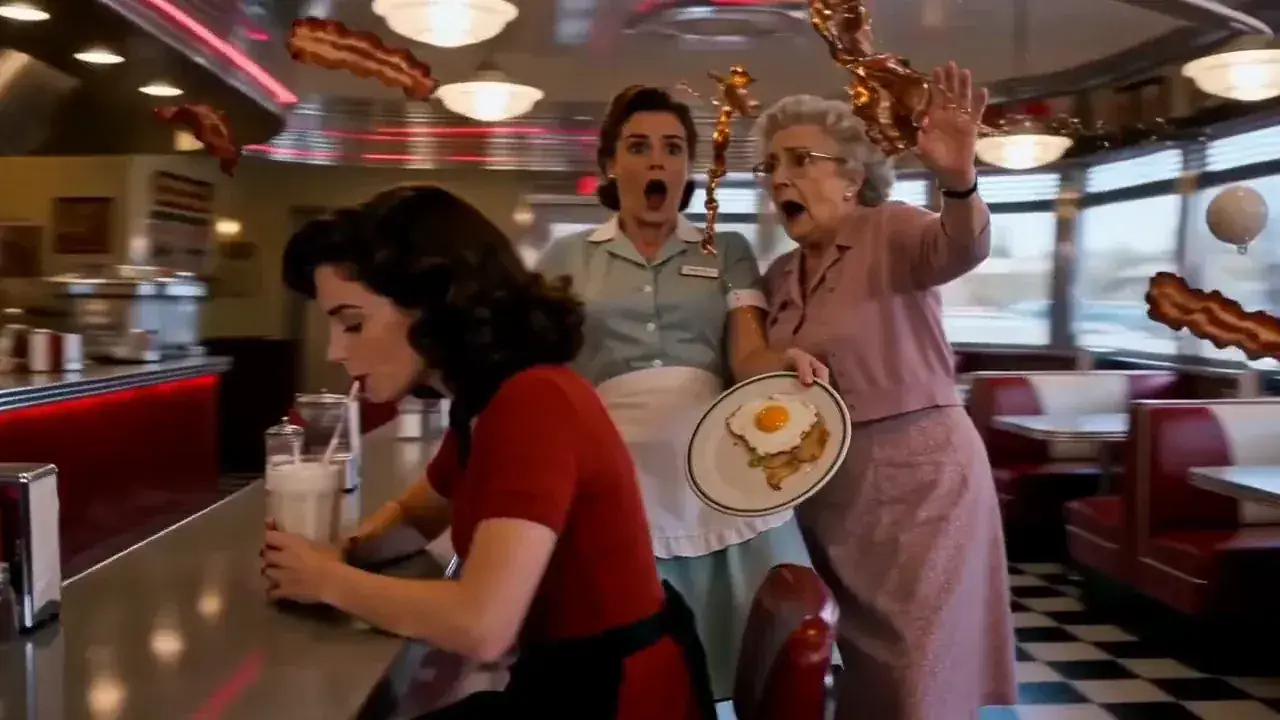
A 1950s diner, a collision, coffee frozen in mid-air, a full orbit and a rewind. The source prompt schedules all of it across thirty seconds in five timed blocks. MiniMax H3 generates a maximum of fifteen. Rather than quietly trimming the prompt, this page shows both versions, because the edit you have to make here is the edit you will have to make to most timed prompts you copy from anywhere.

Steps
One shot
Mode
Text to Video
Duration
15s
Ratio
16:9
Resolution
2K
Audio
Diner ambience + impact
Cost
$1.95

Reference render — not generated on this site. Source: inspova

Output reference

Coffee and breakfast frozen in mid-air in a 1950s diner as the camera orbitsVideo
The clip
1706 / 7000

Images 0/9 · Clips 0/3 · Audio 0/3 · 12 files max

Sign in free · 3 clips a day

No card, no account: watch and download 12 real MiniMax H3 clips, and run one prompt of your own on Agnes Video V2.0 — 16:9, watermarked, once. After that, sign in free for 3 clips a day on the free engine. MiniMax H3 on your own prompt starts at $24.9 a month.

1 FREE CLIP · WATERMARKED

01 — Inside

One prompt, one workflow

The clip beside the verbatim source. Copy it into the console above, change what you need, generate.

Reference output

Coffee and breakfast frozen in mid-air in a 1950s diner as the camera orbitsVideo
The clip
The promptthe clipMiniMax H3 · Text to video
1,706 chars

The fifteen-second cut

Three timed blocks instead of five. The setup and the resolution are gone; the spill, the freeze and the orbit stay, because they are what the prompt is about.

Photorealistic cinematic 1950s American diner, chrome stools, red vinyl, neon glow and checkerboard floor, shot with modern lived-in realism and soft natural window light. Subtle handheld texture, warm practicals, rich period detail, heavy film grain.

0-3s: [Medium Wide] A striking young woman in her early 20s sits alone at the counter, calm and slightly amused, slowly sipping a tall thick milkshake through a straw. Behind her a young waitress in classic uniform approaches with a tray of eggs and bacon in one hand and a full glass coffee pot in the other. An older lady starts rising from a nearby booth.

3-7s: [Dynamic Tracking] The older lady collides hard into the waitress. Tray, plate, eggs, bacon and coffee pot explode upward in chaotic slow motion. Coffee erupts into long liquid ribbons and perfect suspended droplets. Camera immediately begins a smooth continuous orbit around the impact. Time locks completely at the peak of the spill. Every face freezes in pure shock. Only the girl at the counter keeps moving, completely unfazed.

7-15s: [Slow 360° Orbital] Camera glides in a full elegant orbit through the frozen diner. Coffee hangs in mid-air as glassy ribbons and spheres with perfect volume and surface tension. Bacon strips, eggs and the spinning tray float weightlessly. Patrons and waitress remain locked in startled expressions. The girl at the counter takes one slow, deliberate sip, eyes half-lidded, almost bored. Hold on her small knowing smile as the orbit completes.

Photorealistic, ultra-detailed fluid physics, perfect motion blur only on moving elements, stable characters, cinematic lighting, heavy natural film grain, no artifacts, movie-level temporal coherence.

4 levers

Make it yours

What is safe to change. Most libraries publish only this list, which is why so many copied prompts come back worse than the original.

  1. 01

    Where the freeze lands

    At fifteen seconds the freeze has to happen before the halfway mark or there is no time to orbit through it. In the thirty-second original it lands at seven. Moved later, you get a spill and no payoff.

  2. 02

    The unfrozen character

    One person keeps moving. That is the idea. Change who it is — a child, a cook, a dog — and the joke changes with it, but there can only be one.

  3. 03

    The liquid

    Coffee is chosen because it is dark, opaque and forms ribbons. Water is nearly invisible frozen in mid-air; milk reads as a solid. If you swap the drink, swap it for something with colour and viscosity.

  4. 04

    The period

    Chrome, red vinyl, checkerboard, neon. Four nouns set 1955. Replace them with four other nouns and you can move the same gag to a ramen counter or an airport lounge without touching the timing blocks.

Three ways to break it

  • Keeping the thirty-second timeline

    H3 generates four to fifteen whole seconds. A prompt with blocks at 17-24s and 24-30s does not get truncated cleanly — the model compresses the whole schedule into the runtime you actually requested, and every beat arrives early and rushed. This is the single most common failure when copying prompts written for other tools.

  • Cutting the middle instead of the ends

    When you compress a timed prompt, the setup and the resolution are what you delete. The original had a rewind and a punchline at 17-30s; both are gone here. Deleting the orbit instead would leave a prompt with a spectacular idea and no shot that shows it.

  • Leaving the old timecodes in place

    If you delete a block but leave the surviving blocks reading 0-4s, 4-8s, 8-17s, the model is being told the clip is seventeen seconds long while the request says fifteen. Renumber every block after any cut.

What it does

What the diner time freeze template does

Every prompt library on the internet contains prompts written for a different model with a different maximum length, and almost none of them say so. This one is here to make that visible, because it is the failure users hit within about ten minutes of copying their first prompt.

The source is written for thirty seconds in five timed blocks: setup, collision, orbit, rewind, final close-up. MiniMax H3 generates whole seconds from four to fifteen. There is no thirty-second option, no extend, no stitch in a single request. So the prompt has to be rewritten, and how you rewrite it decides whether the clip is good.

The instinct is to trim the end and keep the numbers. That does not work, and understanding why is the useful part. The model does not read "24-30s" and stop at fifteen. It reads a schedule that runs to thirty, notices it has fifteen, and compresses proportionally — so the collision that was supposed to land at four seconds lands at two, the orbit that needed eight gets four, and the freeze that is the entire point of the shot flashes past before a viewer has registered that time stopped.

The correct edit is structural. Decide what the prompt is about, keep that at full length, and delete the rest completely. Here the prompt is about a woman who is unbothered while the world stops around her. That needs the spill, the freeze and enough orbit to show the frozen coffee properly. It does not need the rewind — which was the original's cleverest beat and is the first thing that has to go, because at fifteen seconds a rewind means running the same footage twice and there is not enough footage.

Then renumber. The version above runs 0-3, 3-7, 7-15, and the block boundaries were chosen by asking how long each surviving beat needs rather than by scaling the originals. The orbit gets eight seconds, more than half the clip, because an orbit through a frozen scene is the shot the whole idea exists to produce.

One line was also cut from the tail: "high rewatch value". It is an instruction the model cannot act on, and on a compressed prompt every character you are not using for blocking is a character working against you.

The full thirty-second original is in the source linked at the bottom of this page. It is worth reading next to this version — the difference between the two is the entire skill of adapting a prompt to a model that is shorter than the one it was written for.

Everything here runs in text to video.

6 questions

Diner time freeze — common questions

  • 01

    What is the maximum length MiniMax H3 will generate?

    Fifteen seconds. Durations are whole seconds from four to fifteen, and there is no extend or stitch inside a single request.

  • 02

    What happens if I leave a thirty-second timeline in the prompt?

    The model compresses the whole schedule into whatever runtime you actually requested. Nothing is truncated — everything arrives early and rushed.

  • 03

    Which blocks should I cut when I compress a timed prompt?

    Setup and resolution. Keep the beat the prompt exists to show at full length, and delete whole blocks rather than shortening every block.

  • 04

    Do I have to renumber the remaining timecodes?

    Yes. Surviving blocks that still read up to 17s tell the model the clip is seventeen seconds long, which reintroduces the same compression you were trying to avoid.

  • 05

    Why does the coffee freeze better than water would?

    Opacity and viscosity. Dark liquid holds ribbon and droplet shapes that read clearly when motion stops; water frozen in mid-air is close to invisible.

  • 06

    Can I get the rewind back?

    As a second generation, yes. As part of this one, no — a rewind requires showing the same action twice and fifteen seconds does not have room for both passes.

Copy it, change three things, run it.

Every character is on this page. 15s at 2K costs $1.95.

Generate free