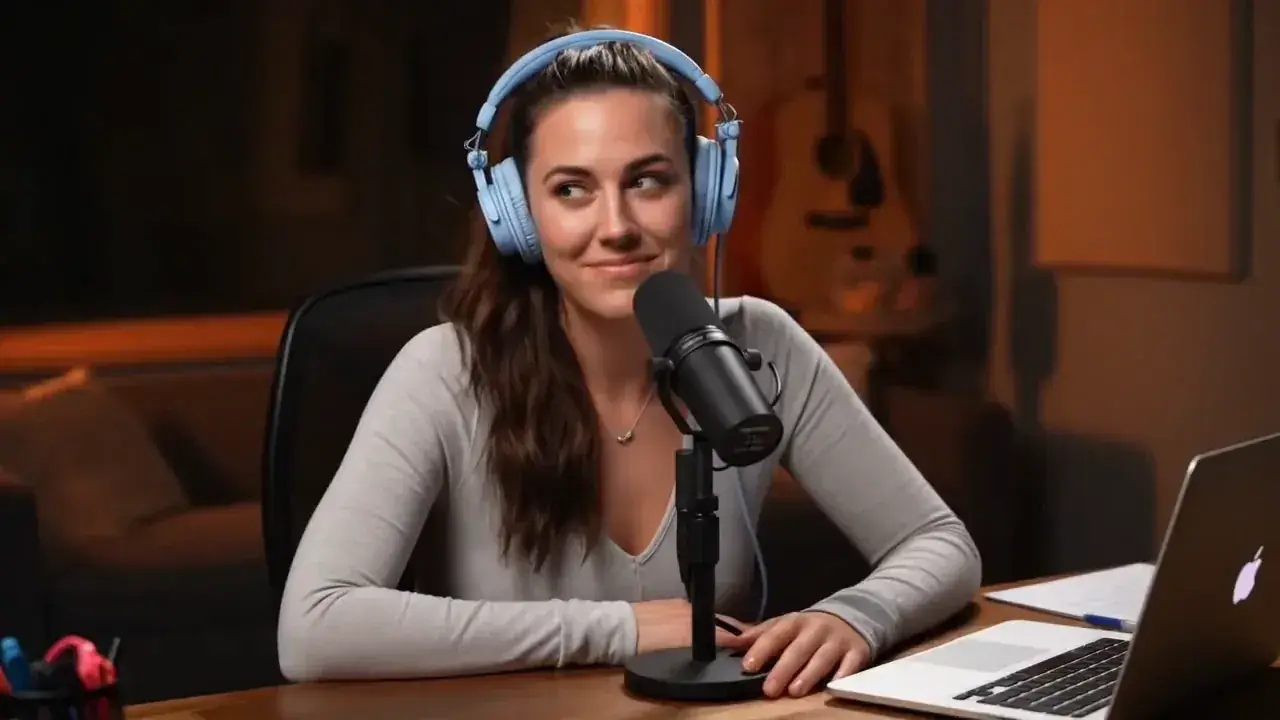
This is a deliberately small prompt and it is here because it isolates one capability. Everything that could distract from the mouth has been removed: the camera does not move, the scene does not cut, nothing enters or leaves the frame, and the background is described in four words.
The result is that the entire generation budget goes to the face. That is not a metaphor — a video model allocates its capacity across whatever the prompt asks it to solve, and camera motion, scene transitions and complex backgrounds all compete with lip movement for the same capacity. The reason this eight-second clip has better sync than any of the fifteen-second multi-scene prompts on this page is not that the model tried harder. It is that this prompt asked for less.
The position of the spoken line matters more than people expect. It sits in the middle of the prompt, immediately after the delivery notes and immediately before the room description. That is the right place, because the words the model reads just before and just after the quotation mark are the ones it associates most strongly with how the line is said. "Whispering" comes before it; "playful" comes after it. Move the line to the very end of the prompt and the delivery flattens, because there is nothing after it to colour the performance.
The word count is a real constraint and worth measuring rather than guessing at. Twenty-two words across eight seconds is about 2.5 per second, which is conversational. This is not a published model specification — it is an observed working figure — but it is stable enough to plan against. If your line is forty words, you need thirteen to sixteen seconds, and fifteen is the ceiling. If it is longer than that, it is two shots.
The last two words of the prompt, "no subtitle", look like an afterthought and are not. Models trained heavily on short-form social video have seen captions burned into most of their talking-head examples, and they will reproduce them. Two words removes an entire class of unusable output, and it is worth appending to any prompt where a person speaks.
The one thing this prompt could add is a room tone line. It describes the light and the mood but never says what the room sounds like, so H3 fills that in. A clause such as "close studio acoustics, no music, faint room hiss" would pin it, and on a whispered delivery the acoustic is half the effect.
 Video
Video